What makes classical music in Italy especially interesting is how inseparable the repertoire remains from the places in which these traditions developed. My training as a classical pianist has changed how I experience a place. I rarely encounter a city only through its architecture, landscape, or famous landmarks. I also listen for the musical language that developed there: the rooms that shaped its sound, the institutions that preserved it, and the composers whose work still shapes how musicians hear.
The history of classical music in Italy is embedded in its churches, courts, theaters, instruments, and regional identities. This is not a definitive musical history but a listening journey through eight places in Italy where geography, architecture, patronage, and musical form continue to converge.
1. Rome: Gregorian Chant and the Living Acoustics of Sant’Anselmo
During the regular academic semesters, the Benedictine community at Sant’Anselmo incorporates Gregorian chant into parts of its 9:00 a.m. Sunday Conventual Mass. This practice is suspended in July, August, and September. Visitors should confirm the current liturgical schedule before planning their visit.
Sant’Anselmo offers a living encounter with one of the earliest foundations of classical music in Italy, allowing visitors to hear how sacred text, communal breath, and architectural resonance shaped Western musical practice.
Hearing chant during an active religious service, rather than in a staged concert, also restores its original function: the architecture, communal breathing, Latin text, and the church’s resonance become inseparable parts of the musical experience.
Before Western harmony evolved into the tonal system familiar to modern listeners, sacred music was organized around modes, melodic contour, text, and collective breath. Gregorian chant is monophonic: rather than several independent parts, the singers share a single melodic line, and it is traditionally performed without instrumental accompaniment.
Below is live footage by the monks at the Church of Sant’Anselmo.
Gregorian chant reveals how architecture becomes part of the music. Without instrumental harmony to guide the listener, attention shifts to the phrase’s shape, the Latin text, communal breathing, and the room’s resonance.
Listen for: how the melody follows the language, how the room lengthens the end of each phrase, and how unison singing can feel spacious rather than thin.
2. Vatican City: Palestrina and the Clarity of Renaissance Polyphony
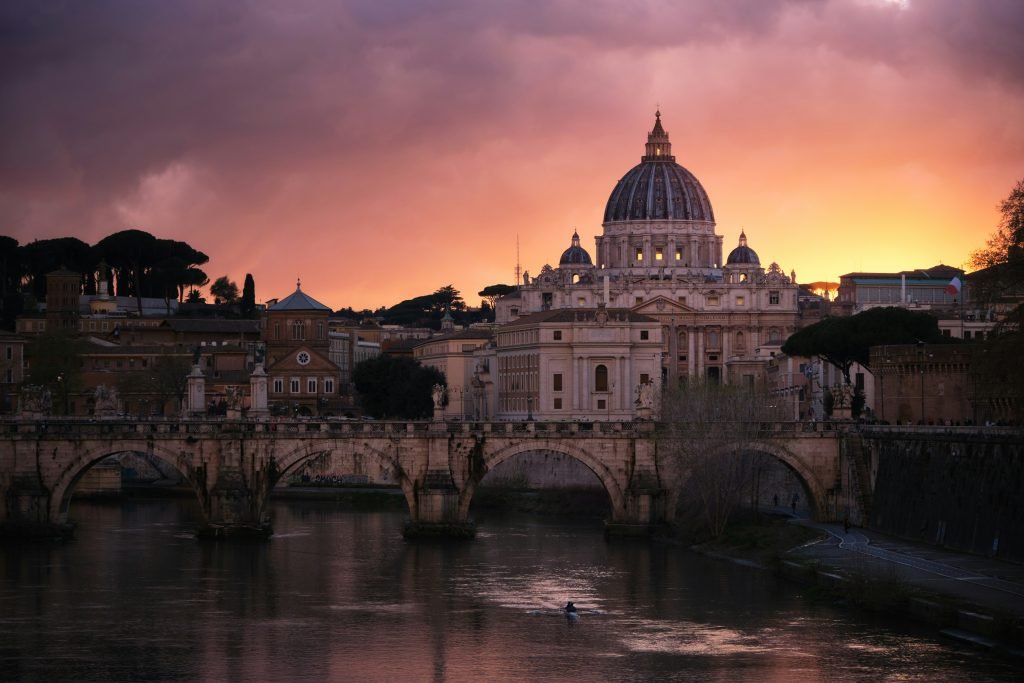
In contrast to Gregorian chant, which is monophonic (one voice), polyphony consists of two or more simultaneous, independent melodic lines. Polyphonic writing became increasingly sophisticated during the Renaissance, enabling several independent melodic lines to contribute to a single coherent musical structure.
Renaissance polyphony became a defining development in classical music in Italy, showing how independent voices could retain their individuality while contributing to a coherent whole.
Giovanni Pierluigi da Palestrina (1525~1594) was an Italian composer and a major influence on the development of Western classical music. He composed hundreds of polyphonic sacred works and spent most of his career in Rome as an organist, composer, and music director for the Catholic Church. Pope Julius III appointed him to serve at St. Peter’s Basilica as the musical director of Cappella Giulia, the choir of the chapter of canons at St. Peter’s Basilica.
Palestrina’s music is often described as serene, yet serenity is not the absence of structure. Dissonance is carefully prepared and resolved, and each vocal line retains its melodic integrity without detaching from the whole.
Today, you can still hear these polyphonic sacred works throughout major Italian cathedrals.
The YouTube footage was from the Good Friday Celebration at St. Peter’s Basilica on March 30, 2018, with the Pope’s Choir performing Palestrina’s Popule meus.
Listen for: how one voice enters after another, how tension appears without disturbing the larger calm, and how the text becomes clearer when the voices briefly move together.
3. Ferrara: Frescobaldi and the Expressive Organ
Ferrara holds an important place in the history of classical music in Italy through its court culture, artistic patronage, and its role in the transition from Renaissance forms toward the greater expressive freedom of the Baroque.
Naples contributed to classical music in Italy through its conservatories, opera houses, influential composers, and distinctive keyboard tradition.

Girolamo Frescobaldi (1583~1643), a musician from Ferrara (northern Italy), was one of the most important composers of organ music in the late Renaissance and early Baroque periods. He later served as an organist at St. Peter’s Basilica for much of his career.
Frescobaldi stands at the transition between the late Renaissance and the Baroque. His keyboard writing retains contrapuntal discipline while allowing musical gestures to hesitate, accelerate, interrupt, and shift emotional direction.
For pianists, this music shows that expression does not depend solely on dynamics. Because the music predates the modern piano, shape must emerge from articulation, pacing, ornamentation, and the handling of tension and release.
Frescobaldi’s early musical life grew up in a city shaped by the Este court’s patronage of architecture, painting, and music. Ferrara’s broader artistic inheritance remains at the Pinacoteca Nazionale di Ferrara, housed in the Palazzo dei Diamanti and devoted largely to the Ferrarese school. The collection does not explain Frescobaldi’s music directly, but it helps place him within a cultural environment in which different art forms developed through overlapping systems of courtly support, technical discipline, and experimentation.
Listen for: the sudden changes of character, the use of ornamentation as musical rhetoric rather than surface decoration, the flexibility of the pacing, and the tension between contrapuntal discipline and expressive freedom.
4. Naples: Scarlatti and the Keyboard as Theatre
Naples reveals another side of classical music in Italy, where keyboard writing, theatricality, and operatic culture developed in tandem.
During the Baroque period, the harpsichord became the dominant keyboard instrument in Europe. Many harpsichord works in various styles, including dance suites, fantasias, and fugues, were published during this period. Domenico Scarlatti (1685-1757), an Italian composer who was born in Naples, is known for his 555 keyboard sonatas. Born into a family of musicians in Naples, Domenico’s renowned father, Alessandro Scarlatti, was also a musician, and the city named a commercial street (Via Alessandro Scarlatti) after him.
Although Naples formed Scarlatti’s earliest musical environment, it marks only the beginning of his career. He later worked in Rome before entering royal service in Portugal and eventually moving to Spain, where he spent the remainder of his professional life serving Maria Barbara, first as princess and later as queen. Much of the keyboard language for which he became known developed within this Iberian context, making his sonatas the product of a musical life that spanned several courts and cultures rather than a purely Neapolitan tradition. You can read more about Scarlatti’s career and musical development through Deutsche Grammophon.
Their compact scale can be deceptive. Within a few minutes, a single sonata may include hand crossings, repeated notes, abrupt contrasts, guitar-like textures, unexpected dissonances, and leaps that test both the player’s coordination and imagination.
As a pianist, I find Scarlatti useful because his music exposes the difference between speed and vitality. Fast notes alone don’t create character; the performer must understand the physical gesture behind the phrase.
Listen for: the athletic hand crossings, insistent repeated notes, guitar-like textures, and abrupt harmonic turns — and notice how the music distinguishes mere speed from genuine rhythmic vitality.

For visitors who want to encounter Naples’s musical inheritance beyond biography, the Teatro di San Carlo offers a living connection to the city’s later operatic tradition. Opened in 1737, after Scarlatti had already settled in Spain, it should not be presented as a place directly connected to his career. Its relevance lies in how it continues to reflect Naples’s identity as a city where music is embedded in public, architectural, and cultural life.
5. Pesaro: Rossini and the Architecture of Comic Timing
Born in Pesaro in 1792, Gioachino Rossini became a defining composer of early nineteenth-century Italian opera, creating works such as Il barbiere di Siviglia (The Barber of Seville). The house where he was born is now preserved as Casa Rossini, a museum that connects the composer’s personal beginnings with the musical legacy Pesaro continues to cultivate.
Pesaro demonstrates that classical music in Italy remains active through performance and festival culture rather than surviving only in archives and museums.
Established in 1980, the Rossini Opera Festival is devoted to performing and studying Rossini’s work, including operas that appear less frequently in the standard international repertory.
As a beautiful Italian coastal city, Pesaro isn’t well known among foreign travelers.
Listen for: how repetition builds dramatic pressure, how vocal agility reveals character, and how the ensemble creates organized chaos without sacrificing precision.
6. Roncole, Busseto, and Parma: Verdi’s Dramatic Landscape
The history of classical music in Italy takes on a more explicitly dramatic and political dimension with Giuseppe Verdi (1813–1901), who had become a dominant figure in Italian opera by his thirties. Born in Le Roncole, in the Emilia-Romagna region, Verdi spent his childhood and early teenage years in Busseto before moving to Milan. Today, Busseto is known as “The Land of Verdi” (
Verdi understood that opera becomes powerful not simply because the music is beautiful. The drama must move through the music. A melodic line can reveal political pressure, private loyalty, grief, humiliation, or the cost of a decision.
Listen for: Across Verdi’s operas, notice how the vocal line conveys moral conflict rather than emotion alone; how the orchestra can alter our perception of a character, sometimes complicating what the words seem to say; and how private desire, loyalty, or grief comes under pressure from family, society, and political power.
7. Lucca and Torre del Lago: Puccini and the Intimacy of Operatic Detail
Puccini’s operas are remembered for their sweeping emotion, yet their force often rests on small details. A conversational phrase, recurring sonority, orchestral color, or melodic fragment can reveal what a character cannot yet say directly. I’ve returned to that relationship between sound and silence elsewhere in my writing on listening, stillness, and musical presence.
Puccini brought classical music in Italy closer to the modern theatrical world by using orchestral color, recurring motifs, and everyday gestures to convey psychological information.
Giacomo Puccini (1858–1924) is best known for La bohème (1896), Tosca (1900), Madama Butterfly (1904), and Turandot (1926). La bohème follows a group of young artists living precariously in nineteenth-century Paris, with Rodolfo and Mimì’s relationship at its center. Yet Puccini’s achievement lies less in the plot than in how recurring orchestral colors and melodic fragments make memory, hesitation, intimacy, and loss audible. The opera draws on Henri Murger’s Scènes de la vie de bohème, and Puccini’s student years in Milan gave him firsthand familiarity with artistic camaraderie and financial uncertainty.
Born in a musical family in Lucca, Tuscany, Puccini’s great-great-grandfather was the maestro di cappella of the Cattedrale di San Martino in Lucca, and the composer himself was a member of the boys’ choir and later a substitute organist.

The Puccini Festival is held annually at Torre del Lago, where Puccini later lived and worked.
Listen for: Notice how specific orchestral colors recur throughout La bohème and how short melodic fragments return with altered meaning as the characters’ relationships develop. The orchestra often conveys what the characters cannot — or will not — say directly. Also listen for Puccini’s use of silence and delayed harmonic resolution: moments when fulfillment is withheld just long enough for anticipation, uncertainty, or grief to become part of the drama.
8. Moderna: Pavarotti and the Discipline Behind an Open Sound
Modena carries the history of classical music in Italy into the modern era through Luciano Pavarotti (1935–2007), whose international career brought Italian operatic singing to an exceptionally broad audience. Pavarotti’s international popularity sometimes obscures the technical discipline behind the apparent ease of his singing. Breath coordination, resonance, vowel formation, diction, musical line, and an intelligent relationship with the text must work together for a voice to sound that open and immediate.
Despite his international career, Pavarotti remained closely connected to Modena. He brought internationally known musicians to the city through his Pavarotti & Friends benefit concerts, and Modena Cathedral held his funeral after his death in 2007. Modena was therefore more than his birthplace: it remained central to his personal identity, charitable work, and public legacy.
Today, Pavarotti’s home in Modena has been converted into a museum that houses his personal belongings and other items from his legendary career.
Listen for: the continuity of the breath, the clarity of the vowel at the top of the range, and how technical security enables emotional directness without forcing.
Looking across these eight places, classical music in Italy begins to look less like a chronology of famous composers and more like a network of cities, buildings, instruments, patrons, and performance traditions.
How Place Shaped Classical Music in Italy
Music never develops in abstraction. It responds to the rooms where it is written and performed, the institutions willing to support it, the instruments available to musicians, and the social conditions that determine whose work is heard and preserved.
Churches and theaters do more than contain music. Their acoustics shape how voices are arranged, how long a phrase can linger in the air, and how composers imagine the relationship between performers and listeners. Courts and religious institutions provided musicians with education, employment, commissions, and audiences, but they also controlled which forms of music received resources and which musicians entered the historical record. The history of music is therefore also a history of access, patronage, and power.
Instrument design also shapes musical possibility. The development of the organ, harpsichord, piano, and the modern operatic stage continually expanded what composers imagined the human body and musical technique could accomplish. Festivals and museums now extend that relationship into the present. At their best, they do more than commemorate a famous person; they keep the music in rehearsal, interpretation, disagreement, and public life rather than turning cultural inheritance into a frozen monument.
The relationship between music and place extends beyond Italy. At a concert inside a centuries-old church at the Ohrid Summer Festival in North Macedonia, I experienced how stone, sacred history, architectural resonance, and accumulated cultural memory became active elements of the performance. The setting didn’t merely contain the music; it changed how silence, time, and sound were perceived.
These eight places represent only one route through the history of classical music in Italy. Venice, Milan, Cremona, Bologna, Florence, and many other cities could each sustain their own musical journey. For me, traveling through classical music in Italy is compelling because a destination becomes more than scenery, and a composition becomes more than an isolated work.