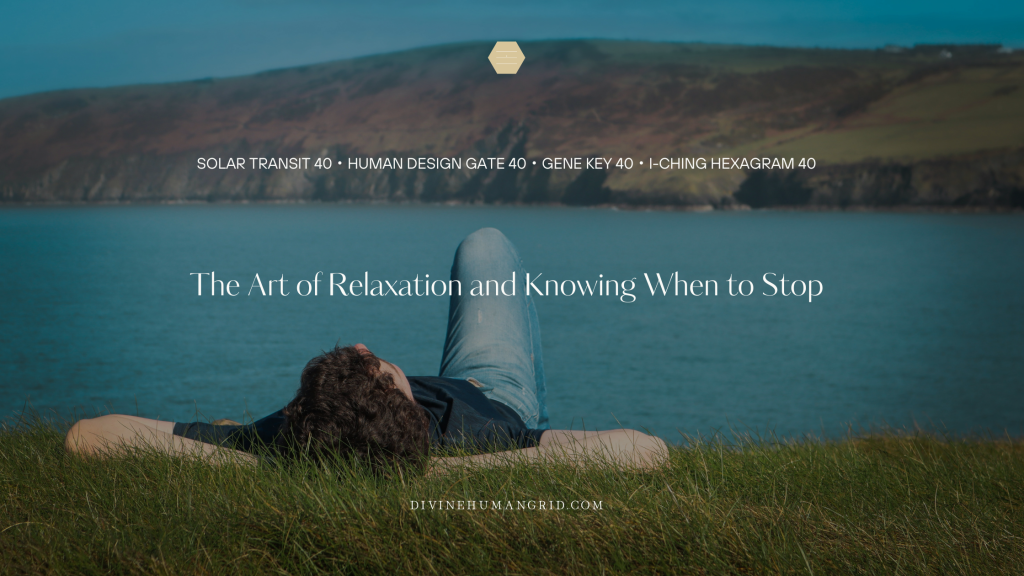
Human Design Gate 40 is about the will to work, provide, and deliver, but equally about the right to stop once the work is complete.
Located in the Heart/Ego Center, Gate 40 carries powerful will energy that can support family, community, business, and the people it has committed to. Yet this energy is not meant to remain permanently available. After giving, working, or fulfilling its part of an agreement, Gate 40 needs space to withdraw, recover, and be free of demands.
This is why Gate 40 is also known as the Gate of Aloneness and Deliverance. Its deeper lesson is not merely how hard you can work, but whether you recognize when you have done enough.
Through the 37–40 Channel of Community, Human Design Gate 40 participates in one of Human Design’s clearest energetic bargains: I will contribute my will and resources, but the relationship must also support me.
When that exchange loses balance, giving can become overgiving, duty can turn into resentment, and willpower can give way to exhaustion.
Gene Key 40 traces this movement from the Shadow of Exhaustion to the Gift of Resolve and, finally, to Divine Will. The answer to exhaustion is not necessarily doing nothing. It is learning what deserves your will, what does not, and when genuine resolve has already done its work.
Rest is part of the bargain, not a reward for being exhausted.

Gate 40’s need for aloneness is closely connected to what it gives. This energy can work hard, provide, support, and fulfill agreements, but the 37–40 bargain also requires reciprocity. When you continually give without receiving the support, appreciation, resources, or space that sustain the exchange, exhaustion can easily turn into resentment.
When that exchange loses balance, duty can turn into resentment and willpower can turn into exhaustion.
This is why Human Design Gate 40’s withdrawal is not necessarily a rejection. Sometimes being alone is simply how the will recovers after we’ve delivered. I-Ching Hexagram 40, 解 (Xiè), is traditionally associated with Deliverance or Release. Its underlying movement raises the same question:
Once the difficulty is resolved, can you release the tension that helped you move through it, or do you continue to struggle because effort has become familiar?
This is also where the Taoist principle of Wu Wei is especially useful. I actively practice and apply Wu Wei when supporting and guiding my clients because it offers another way to understand the balance between effort and release.
Resolve doesn’t always need to happen through pushing overboard.
Wu Wei is often translated as effortless action or non-forcing. It does not mean doing nothing — it means acting without adding unnecessary struggle beyond what the situation requires. This Taoist principle has deeply shaped my understanding of effort, surrender, and timing: rather than forcing life into the shape the mind prefers, notice what is already moving and respond without unnecessary interference.

With Gate 40, the key is distinguishing resolve from force. You can be deeply committed without constantly over-pushing. The distinction is also crucial because resolve can work extremely hard when something truly deserves your will, but it also knows when further effort would no longer improve the outcome.
Wu Wei does not ask you to avoid difficulty or become passive. It asks you to stop adding unnecessary resistance. Sometimes the path of least resistance still requires effort, discipline, or an uncomfortable conversation. The difference is that you are no longer wasting willpower fighting what does not need to be fought. The art of relaxation is knowing when effort becomes interference. What this energy is really asking is: Are you working with the movement already unfolding, or trying to force the Universe to move on your preferred timeline?
Trusting doesn’t equate to believing.
Belief can remain mental. Trust changes how tightly you grip the outcome. For Human Design Gate 40, this matters because willpower becomes exhausting when it is used to control every stage of a process rather than to fulfill the part that is truly yours. Trust doesn’t remove responsibility, but it does help you recognize where your responsibility ends.
Meditation, breathwork, time in nature, and genuine physical rest can help you notice when your will is still available and when you are continuing purely on momentum. The purpose is not to become passive but to create enough internal space and silence to recognize when effort is still useful and when your body is asking for recovery.
Research on recovery from work similarly associates persistently limited opportunities for recovery with greater physical and psychological fatigue.

Willpower is a resource, not a permanent operating mode.
Human Design Gate 40 invites you to examine how you use your will and whether you allow your body to recover after that effort. Willpower is something to exercise, not something to keep permanently contracted. Just as physical strength requires both exertion and recovery, Human Design Gate 40 works best when effort is followed by genuine release — not every situation needs to become a HIIT workout for your willpower.
At the highest frequency of Gene Key 40, Resolve yields to Divine Will. It doesn’t mean losing agency or passively waiting. It means your personal effort no longer needs to fight reality.
You do what is yours to do and stop trying to carry what was never yours to control.
This distinction can be subtle, especially when effort is disguised as conscious creation, so the question to ask here is:
Am I working with reality to move something forward, or trying to force reality to validate what I have already decided must happen?
Gate 40 teaches that resolve becomes clearer when willpower is no longer spent trying to control every possible outcome.
Questions for working with Human Design Gate 40
- Where am I giving more than was actually agreed?
- What do I expect in return, and have I communicated that?
- Am I tired because the work genuinely demands this much from me, or because I keep proving I can carry the load?
- Do I allow myself to be unavailable after I have delivered?
- Have I mistaken being needed for being valued?
- What would “enough” look like here?
- Can I rest before exhaustion forces me to rest?
- Is this commitment still reciprocal?
Human Design Gate 40 teaches that the ability to work hard is only half of healthy willpower. The other half is recognizing when you have fulfilled your part, allowing yourself to withdraw, and trusting that rest does not invalidate your contribution.
Resolve does not mean endlessly proving how much you can carry. It means knowing what deserves your will and giving yourself fully when it does — without mistaking exhaustion for devotion.
You do not have to destroy your capacity before you have earned the right to rest. Explore the complete Human Design Gates, Gene Keys, and I-Ching Library.